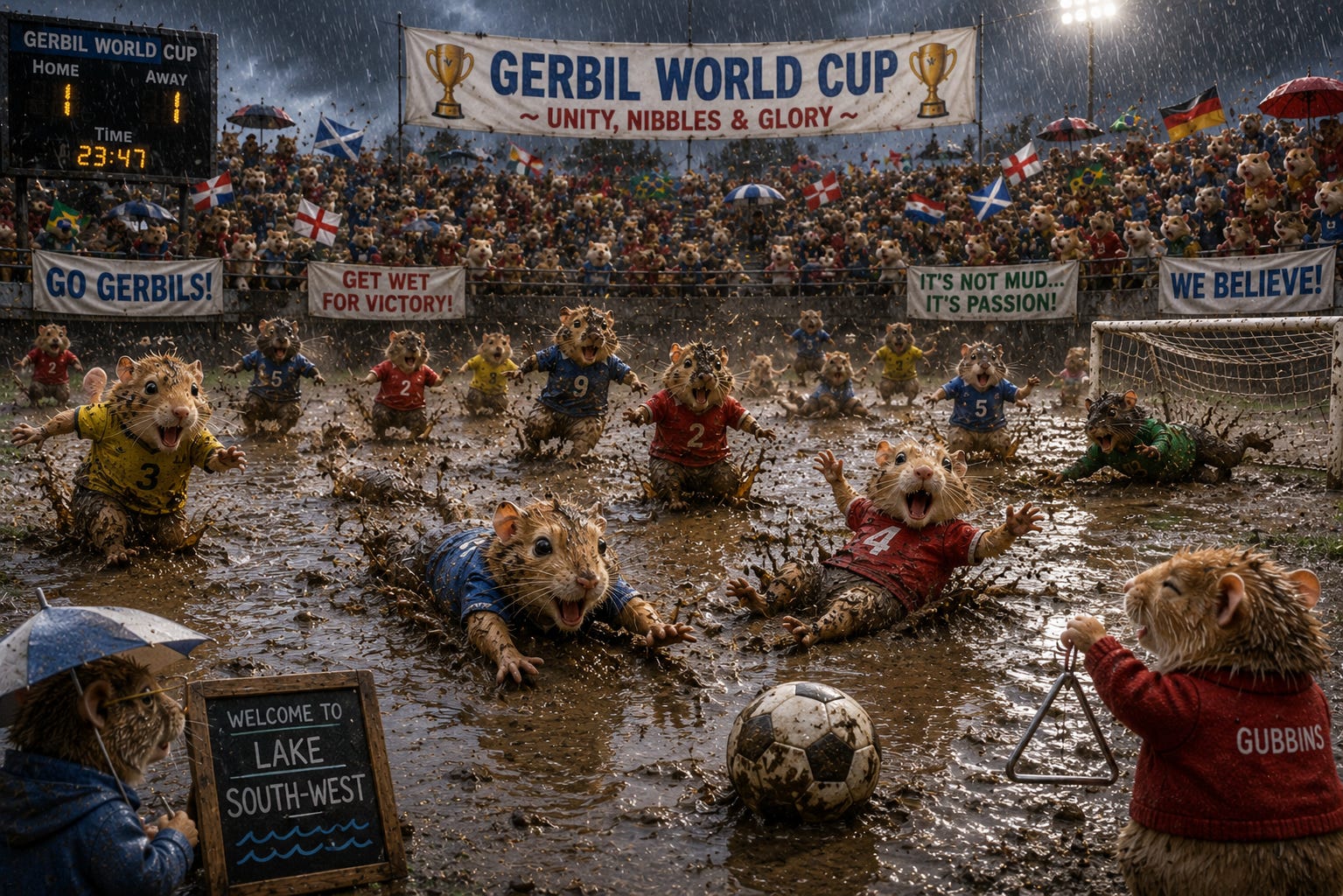

The third match of the Gerbil World Cup attracted the largest crowd yet. Word had spread. Nobody was entirely sure what had spread. Some claimed it was news of the football. Others believed it was news of the chaos. Either way, the stadium was full long before kick-off. Flags fluttered from every railing. Supporters packed the stands. Gubbins had somehow acquired a larger triangle.
The teams emerged to a tremendous roar. The elephant shrew referees marched onto the pitch with expressions suggesting that they had prepared thoroughly for every possible eventuality. This confidence lasted approximately four minutes.
The weather had been pleasant all morning. Bright sunshine illuminated the stadium. Not a cloud was visible anywhere overhead.
As the players lined up for kick-off, Geography happened to glance towards the horizon. She frowned. There was a cloud. It was not an especially large cloud. Nor was it moving particularly quickly. It simply sat there in the distance looking suspicious. Geography continued watching it.
The cloud appeared to be growing. A few moments later there were two clouds. Then four. Then what seemed to be an entire committee of clouds.
The crowd paid no attention. The whistle blew. The match began. For nearly ten glorious minutes, football happened. Not good football. Not even competent football. But recognisably football. There were passes. There were tackles.
Grenadine successfully dribbled around three opponents before becoming distracted by cheering and accidentally joining the crowd. The spectators loved it.
Then a raindrop landed on Gadget’s nose. She looked upwards. Another landed. Then another. Around the stadium, heads tilted towards the sky. The players slowed. The crowd murmured. The elephant shrews exchanged glances.
Rain was not particularly unusual. The amount of rain arriving, however, was becoming noteworthy. Within moments the shower had intensified into a downpour. Flags drooped. Programmes dissolved. The crowd squealed. The pitch darkened. Water splashed beneath every running paw.
Still the match continued. At first the conditions merely made football more difficult. Then they made football irrelevant. Gladioli attempted to stop suddenly and travelled another six metres. Gazpacho launched herself heroically towards the ball and accidentally reached the halfway line.
Several players discovered that sliding through puddles was vastly more entertaining than scoring goals. The crowd rose to its feet. Nobody was watching the football anymore. The football had become secondary. The real spectacle was the mud.
The pitch was transforming before their eyes. Patches of grass disappeared beneath shining pools of water. Channels formed. Puddles merged. Entire sections of the field developed distinct personalities. One corner became known as Lake South-West. Nobody remembered naming it. The name simply appeared.
The ball rolled into the lake and stopped. Twenty-two players charged after it. What happened next could no longer reasonably be described as football. Gallantine reached the puddle and slid straight through it. Grapejuice followed. Then Guppy.
Within seconds the entire match had become a mass participation mud-slide. Players hurled themselves across the pitch. Supporters abandoned the stands. Even the elephant shrew referees found themselves skidding uncontrollably through several feet of water.
The stadium erupted with delight. The rain continued falling. The mud became deeper. The slides became longer. Soon elaborate techniques were being developed.
Granite achieved remarkable distance by launching from a small mound. Glyph attempted to diagram the optimal trajectory while moving. Gubbins slid past carrying her triangle above her head like an Olympic torch. Nobody had the faintest idea where the football was. Nobody cared.
The World Cup had discovered a new sport. And it was magnificent.
← Previous Instalment | Next Instalment →