
Gosie had not expected to see anyone she knew in Norwich, which made it all the more surprising when the first thing she saw on entering the Close was EdithStourton, accompanied by her dogs, Brains and Batshit.
“Brains. Batshit.”
Both dogs sat. Batshit sat on the edge of the kerb and slid off it.
“Edith.”
“Gosie.” Edith did not seem remotely surprised by the coincidence, in the way that nothing much ever seemed to surprise Edith. “I didn’t know you were still on the cathedral circuit.”
“I didn’t know you were in Norwich.”
“Passing through. Brains wanted to see the river.” Edith said this as though it were a perfectly ordinary reason for a dog to want anything. “She’ll have to stay outside with Batshit. They don’t allow them in, which Brains considers a personal insult, given how well behaved she is right up until the moment someone tells her she can’t come in.”
“I see Batshit’s seen a pigeon,” said Gosie.
The pigeon walked three steps to the left, stopped then took three steps forward. Batshit followed it, then stopped, apparently having reached the end of the plan.
“She won’t get any further than that,” said Edith. “Let’s go in while they’re both occupied. They’ll find a sunny patch and wait.”
Norwich Cathedral did not pretend to be simple, which Gosie appreciated after weeks of cathedrals that either had too little glass to explain or too much explaining to do about the glass they had. The medieval windows had gone the way medieval windows generally went in England, the Reformation first, then the Civil War for anything that had survived the Reformation, leaving a scatter of fragments in the Deanery and not much else. But Norwich, unlike so many of the others, had simply decided to start again. An 1830s refurbishment had taken the opportunity to reintroduce stained glass wholesale, and nobody since had seen much reason to stop. Victorian glass sat beside surviving medieval fragments sat beside war memorial windows commissioned when the Dean and Chapter had encouraged the leading families to give something worth remembering their sons by, and beside all of that, in the north transept, glass that was frankly modern, panels that any other cathedral would have hesitated to hang so close to something six hundred years older.
It meant, Gosie thought, standing in the nave with her notebook not yet out, that here of all places nobody would look twice at a piece of old glass appearing somewhere new. That was rather the point of the building.
Edith had come for the north transept, she said, in the way people say things when the real reason is a little harder to explain, and Gosie found she had done exactly the same. Recent contemporary work was easiest to date and therefore easiest to rule in or out, and there was nothing there beyond glass that was exactly as recent as it claimed to be. It was the medieval fragments that stopped her, tucked into a smaller window on the south side, incorporated the way the survey described it, respectfully, sparingly, into a surrounding scheme of nineteenth century glass built specifically to house them.
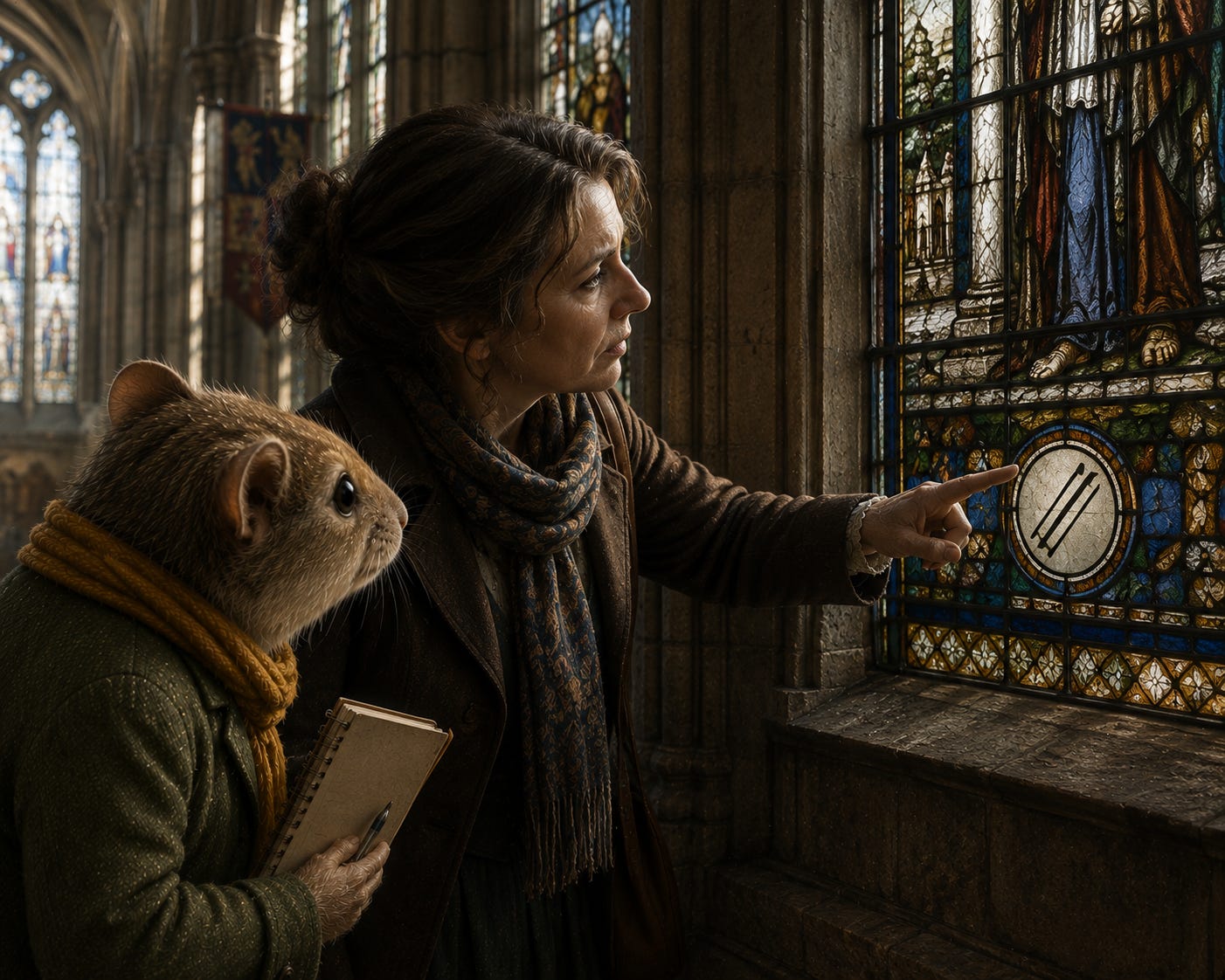
The fragments were meant to look old. That was their entire purpose, survivors given a dignified setting rather than a disguise. Which was exactly why it took her longer than it should have to notice that one small roundel, low in the border, was not old at all. The colour was right. The wear was right, or close enough that she had walked past it twice already. But the leading around it had the same faint brightness she had learned to recognise at Durham.
Edith was already looking at it when Gosie turned back.
“There,” said Edith, and pointed, before Gosie had said a word about what she was looking for.
It took Gosie a second to find it, low in the border of the roundel, and then she wondered how she had missed it on first glance at all. The circle. The three diagonal lines. Smaller than at Durham, worked in more carefully, but unmistakably the same mark.
She stood very still and looked at it for a long moment, the way she had at Durham, the way she had at Ripon.
“That one’s odd,” said Edith, after a moment.
“Odd how?”
Edith looked at it a moment longer before answering. “It’s out of true. Just here.” She nodded at the smallest section of the circle, low on the left. “The rest of it’s machine pressed. But that bit isn’t.”
Gosie looked again, and saw what she meant. The faintest waver in the line, the kind of imperfection a machine press would never produce.
She photographed the leading again. Then she stood back and made herself stop looking at it, because she had learned by now that staring at a thing did not usually make the questions resolve any faster.
She took out her notebook. Norwich, she wrote. South window, medieval fragments, recent roundel, symbol confirmed. Then, underneath, because the question still hadn’t resolved itself and she had learned not to force these things: something else. Ask at the Bluestocking.
Previous Chapter | Contents | Next Chapter