
Gosie left Christmas Stars’ farmhouse in the morning, notebook restocked, and pointed the car south rather than straight back to the Bluestocking. Peterborough was on the way, more or less, if you were willing to take the phrase more or less rather further than it usually stretched, and there had been a cathedral there she had never quite crossed off the list properly, a chapter house lost to the Dissolution and rebuilt in a style the survey described, unhelpfully, as sympathetic Victorian.
Sympathetic Victorian turned out to mean thorough, well documented, and entirely free of anything resembling a circle crossed by three diagonal lines. Gosie spent two hours confirming this, spoke to an archivist who was extremely proud of the roof bosses and wanted her to be proud of them too, and left with a good deal of new information about roof bosses and nothing whatsoever about Talmere.
She got back to the Bluestocking in the early evening, Christmas Stars having driven up separately to collect a delivery of her own and stayed on for the fuss, to find gerbils arranged around the noticeboard in a configuration that suggested an announcement rather than an ordinary evening.
“There’s a letter,” said Hedgehog, holding it up before Gosie had taken off her coat.
“For you,” she added, in case this had somehow been unclear.
“It’s got a postmark,” said Christmas Stars, with the particular satisfaction of someone whose own prediction was about to be proven right. “From the Fens.”
Gosie took the envelope. Her own name was written across the front in a hand so precise it looked printed, dark ink, perfectly weighted strokes, the kind of handwriting that suggested whoever held the pen had opinions about the pen.
She opened it carefully. Inside was a single sheet, and on it, in the same exact hand, a short paragraph stating that Ms Burnish was, at present, too occupied for an appointment, but that she had been most taken with the notepaper, and appreciated the effort of writing.
“That’s not a no,” said Hedgehog, reading over her shoulder before Gosie had properly finished the first read herself.
“It’s not a yes either,” said Gosie.
“It’s a maybe,” said Christmas Stars, with the confidence of someone who had decided this was good news and did not intend to be talked out of it.
Gosie folded the letter and put it in her pocket. She had a name confirmed and a compliment about stationery. She did not have a meeting, a date, or anything resembling an angle, and the silence since the workshop had begun to feel less like patience and more like a fact she was going to have to live with.
It was sitting with that particular flavour of frustration, the letter refolded twice, then a third time, that she remembered the other name.
Brennard and Vye. It had been in the Durham file since the very first afternoon with Judith, a name she had written down, underlined once out of habit, and never once followed up, because Fenhurst and Rhys had seemed the obvious thread to pull and there had been no reason at the time to pull two threads at once. There was, she thought, no reason not to now.
Brennard and Vye turned out to be considerably easier to find than their counterpart, a converted mill on the edge of a market town with a sign by the road and a car park with actual markings on it, as though the workshop expected to be visited and had planned accordingly.
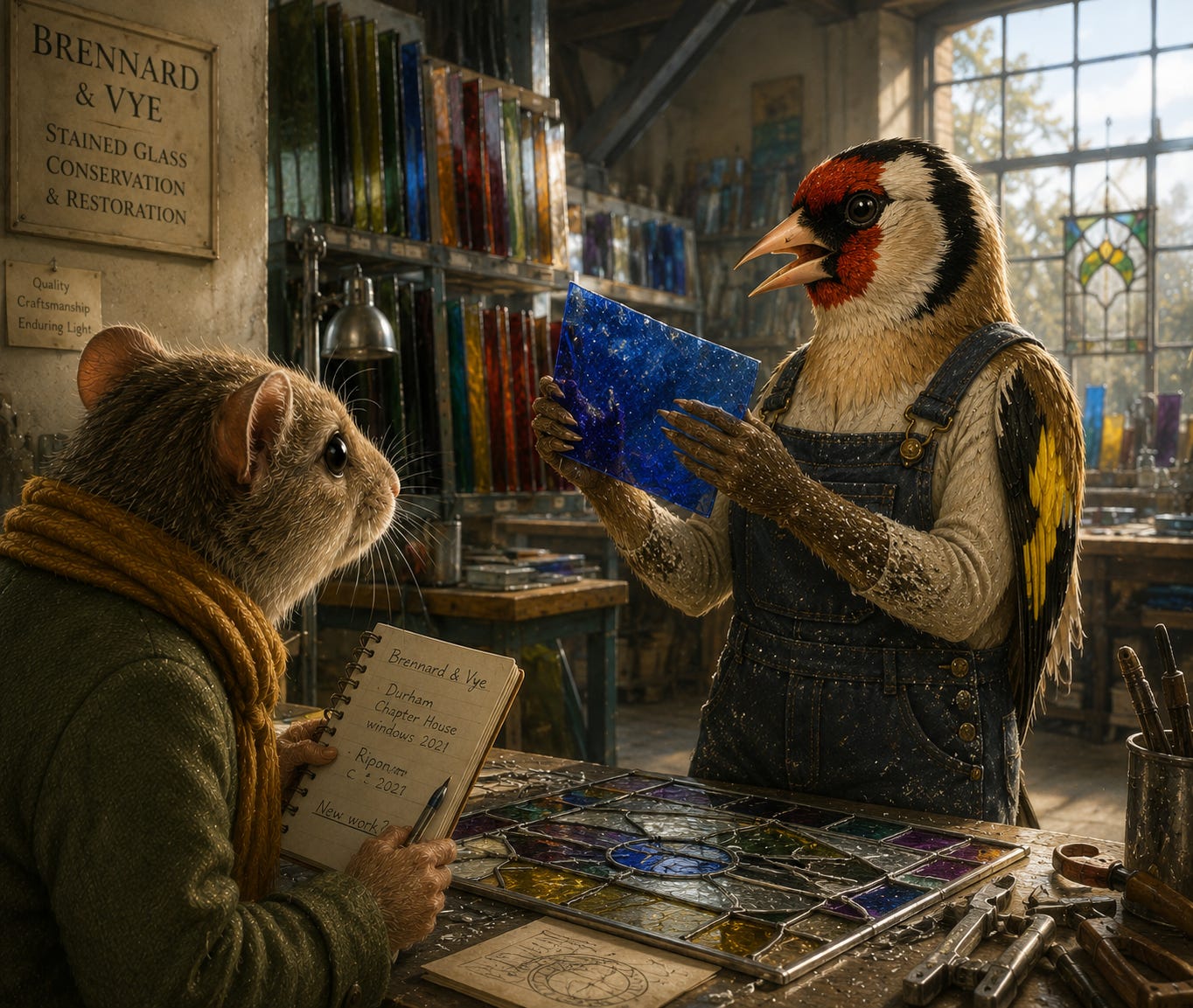
The door was answered before Gosie had properly finished walking up to it, by a goldfinch in overalls dusted along one sleeve with something that caught the light like ground glass.
“You’ll be about the enquiry,” said Gemma Glasswing before Gosie had said anything at all, leading her through a workshop that smelled of hot metal and something faintly resinous, glass in every colour imaginable stacked in racks along one wall. “Good you’ve come. We’ve got the availability, whenever you need it.”
Gosie, who had not yet said what she was there for, took a moment to catch up. “Availability?”
“For new work. Isn’t that what this is?” Gemma set down the piece of glass she’d been carrying, unbothered, already halfway into an explanation she’d evidently given more than once recently. “We’ve all had calls, workshop after workshop, everyone asking the same thing, could we take something on, how quickly. Strange, after this long. We had years of it, mind, steady as anything, right through the pandemic when everyone else was living off furlough or patching roofs. Then nothing, dead quiet. Assumed the money had dried up, or whoever it was had simply finished.”
“Had they?”
“Seemed that way. Norwich Cathedral was the last new commission, best part of two years ago now. These things take time, restoration work, and that one only finished and delivered a few months back. Nothing fresh started since. Not until now.”
Gemma turned the glass over in her hands without really looking at it, the way people handle something too familiar to need watching. “And now suddenly it’s started again. Nothing confirmed yet, as far as I know. Just the asking.”
Gosie took out her notebook, and did not correct the assumption Gemma had made about why she’d come. “Durham,” she said instead. “The chapter house windows, 2021. That was part of the steady work?”
“That was ours, yes. Ripon too, around the same time.” Gemma said it plainly, the way she’d said everything else, a fact rather than a confidence.
Gosie wrote it down exactly as it had been said, and found that the useful thing about the afternoon was not Durham or Ripon at all. It was the shape of the whole thing, steady through years when nobody else was, then silence, and now, quietly, beginning again. Somewhere in that silence, something had been finished. Somewhere in its ending, something had apparently gone wrong.
Previous Chapter | Contents | Next Chapter