
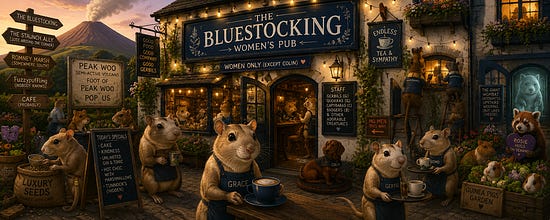

Nearly three weeks later, the Atlantic had grudgingly agreed not to kill them.
Not because conditions had improved particularly. The sea remained cold, iron-grey and personally offensive. But after nearly a month on board The Dreadnork, everybody had begun developing the exhausted emotional numbness normally associated with minor hauntings.
The storm damage had been repaired as well as possible. Several of the great square sails still carried alarming-looking reinforcements stitched by teams of determined gerbils working under the supervision of AuntieDamsonCrumble, whose opinions on rope-work had now become sufficiently feared that even Batshit had stopped chewing important rigging.
Errol and Magpie had spent much of the time scouting the surrounding seas for signs of the missing longboat. Unfortunately Magpie possessed the attention span of an unusually acquisitive corvid and had repeatedly become distracted by shiny fragments of maritime debris, while Errol maintained that the Atlantic Ocean was “unfeasibly large.”
On the main deck, Brains sat calmly beside the starboard rail watching albatrosses with the grave concentration of a philosopher considering difficult moral questions.
Batshit, meanwhile, was ricocheting through the rigging barking at absolutely everything.
“BATSHIT!” EdithStourton yelled upward from the quarterdeck. “You cannot declare war on weather!”
Batshit ignored this completely and vanished briefly upward into the mist.
Near the port rail, several damp gerbils were conducting their daily period of collective grievance.
“We used to have extra dry socks,” one said mournfully.
“And pickled herring,” another added.
“We had civilisation.”
“We had standards.”
“We had Scandinavians.”
Octavia Briefcase glanced up from the chart table. “You lost the Scandinavians nearly three weeks ago.”
“Yes,” said the gerbil darkly. “Exactly.”
After so long at sea, everybody had begun seeing things in fog banks and distant waves. MyrtleLion had calmly pointed out the previous evening that one particular patch of mist looked remarkably like a bishop wearing snowshoes, which unfortunately meant everybody else could now see it too.
Suddenly Batshit zoomed down from the rigging and stood stock still at the prow, with nose twitching and staring straight ahead, her eyes on something Edith couldn’t see. It was as if she had finally discovered her pointer skills. Brains stood up and joined her.
Out of the mist, running smoothly alongside them as though it had merely stepped briefly into another room, came the missing longboat.
Several seconds of complete silence followed.
Then half the gerbils screamed simultaneously and launched themselves toward the port rail. “SCANDINAVIANS!”
The longboat slid neatly alongside beneath the fog, seawater hissing softly against its dark hull. The Norsewomen aboard looked cold, windswept and entirely untroubled by the Atlantic Ocean.
NotAtMyAge raised one hand calmly.
“Terribly sorry,” she called upward. “We appear to have taken a slight detour.”
“A slight—” began Octavia.
“Largs,” explained another Norsewoman. “One had to restock properly and Wolef had plenty of knitted underfugs to keep the essentials warm. And some knitted signal flags. Frankly she gave us as much of her yarn stash as the longboat could carry.”
Several gerbils near the rail closed their eyes briefly with the emotional expression of pilgrims hearing sacred scripture.
EdithStourton stared down at them. “You crossed the Atlantic via Scotland?”
“It seemed sensible at the time.”
Batshit was now tangling herself in the signal flags, barking hysterically with joy while Brains wagged politely at the returning longboat as though this sort of thing happened constantly.
For nearly an hour afterwards the mood aboard The Dreadnork improved dramatically.
Then Errol landed heavily next to the starboard rail.
“I found the yacht!” said Errol. “About eight nautical miles ahead — and there’s land! We’ll reach America in the morning!” she said.
The gerbils exploded. A shriek of celebration went up from somewhere near the rigging and spread instantly across the ship like fire through dry grass.
“LAND!”
“AMERICA!”
“COFFEE!”
Within moments several gerbils had begun an extremely loud sea shanty of doubtful tune but enormous commitment while Georgia launched into an energetic stamping sailor-dance across two barrels and part of the capstan. Germany produced a concertina from absolutely nowhere. Ghana attempted to kiss the deck before remembering it was still damp with seawater and reconsidered.
Batshit launched herself vertically into the mist barking with such hysterical excitement that Brains finally lost her composure and started running delighted circles around the mainmast until it was too much for her digestion.
Even AuntieDamsonCrumble appeared briefly to clap in rhythm before noticing she was doing it and regaining her dignity.
Ahead of them, beyond drifting fog banks, faint clusters of lights had begun appearing intermittently along the dark coastline.
Maine.
After nearly three weeks at sea, it looked almost impossibly solid.
“There!” said Gosie suddenly, pointing toward one brighter concentration of distant lights. “That has to be Portland. It’s enormous.”
“I agree. Only Portland would build four different lighthouses just to guide you to a hipster brewery,” said Octavia.
“But we can’t be certain from this distance,” Gosie said. “And if we can’t catch the yacht now it could disappear into any one of dozens of harbours along this coastline.”
The celebrations faltered. Night closed slowly across the Atlantic. Sometimes lights appeared through the fog. Sometimes they vanished again completely. Every so often somebody announced with enormous confidence that they could definitely see Portland.
Nobody else could.
By three in the morning even the gerbils had gone quiet. At four, while the Atlantic was still black around them, Errol suddenly stood up and launched herself upward into the fog.
“Oh dear,” said Octavia.
Ahead of them the scattered lights of the Maine coastline continued drifting in and out of visibility through the mist while The Dreadnork pushed onward beneath full sail.
Then, far ahead across the darkness, a dull orange glow appeared.
For several seconds nobody understood what they were seeing. Then as the flame climbed slowly upward they saw the yacht’s sails.
Burning canvas glowed deep gold against the black sea while smoke streamed low across the wind. Every few moments the fire brightened again as fresh sections of sail caught, turning the distant yacht into a wavering lantern visible for miles across the Atlantic fog.
Now they could finally follow it.
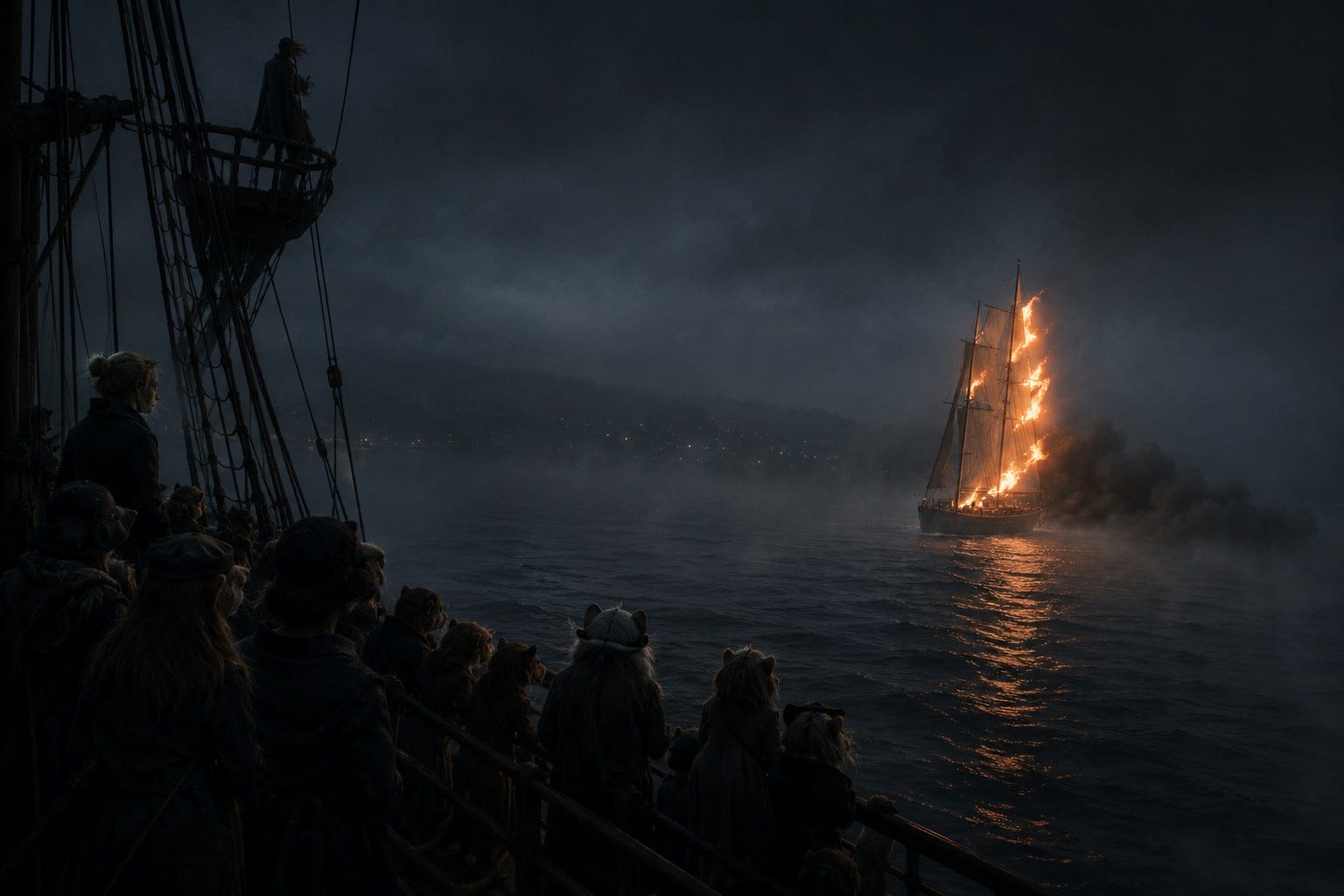
The fire spread higher for several more minutes before figures finally became visible moving frantically across the distant deck. One sail collapsed inward in a shower of sparks while seawater hissed white against the hull beneath it. Then gradually the flames began dying back.
Smoke continued streaming behind the yacht as it powered onward on engine alone, still far ahead of them in the darkness. And gradually, through fog and darkness and smoke, the yacht’s course became unmistakable.
“Portland,” said Gosie at last.
Nobody aboard The Dreadnork cheered this time. They simply watched the smoking yacht continue southward toward the harbour. Only much later, when the first pale hint of dawn began whitening the eastern horizon, did Portland finally emerge properly from the mist ahead: docks, cranes, fishing boats, warehouses and clusters of waterfront lights fading slowly into morning.
Far ahead the yacht was already slipping into the harbour among dozens of other vessels moving across the water.
Gosie stared at it. Then her expression changed. “Oh Errol…,” she said quietly.
She looked at the blackened ruin of the sails. “The symbol,” she said. “How are we supposed to recognise the yacht now… or find the smugglers?”