

By Monday afternoon, Gosie was standing on the deck of a supply boat pitching steadily through a steel-grey Atlantic swell while questioning several recent life decisions.
The crossing west had been long enough for the mainland to dissolve completely into haze behind her. Ahead, Lundy rose abruptly from the sea like something that had decided, quite independently, to become an island.
Steep cliffs.
White water.
Wind hard enough to flatten thoughts.
And puffins.
Hundreds of them.
Gosie had expected the puffins to look dignified and mysterious, given the increasingly dramatic build-up surrounding them.
This expectation lasted approximately fourteen seconds.
One puffin immediately fell off a rock.
Another appeared to be shouting at seaweed.
A third stared directly at Gosie while carrying three fish sideways in its beak with an expression suggesting catastrophic confusion.
“They observe everything,” ChristmasStars had said.
Which now felt less reassuring.
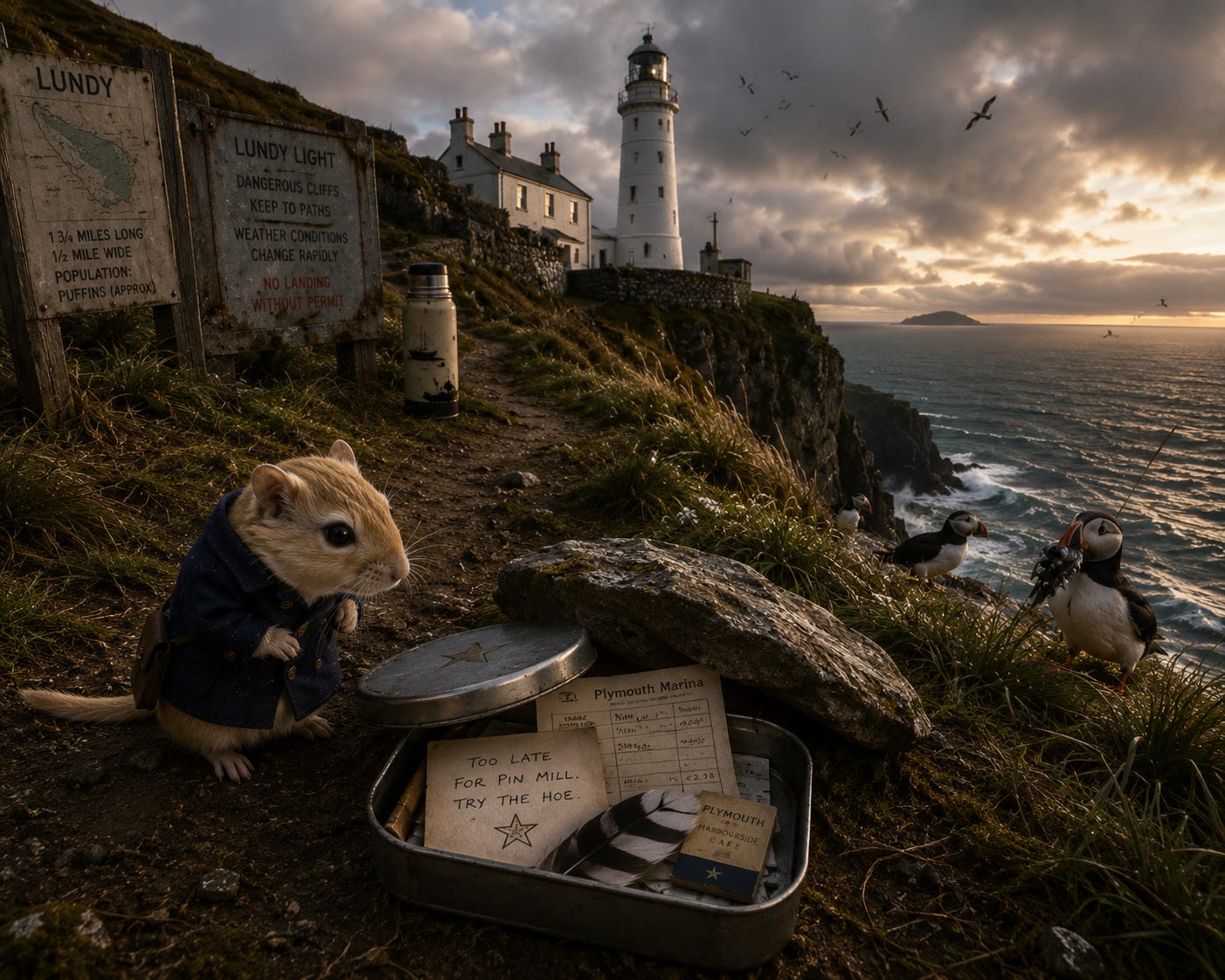
Still, by early evening Gosie had managed to reach the western side of the island where the old lighthouse stood above the cliffs, white against the darkening sky. The Atlantic stretched endlessly beyond it.
There, finally, she found evidence that mattered.
Not hidden.
Waiting.
Wedged carefully beneath a flat stone near the lighthouse path sat a small waterproof tin marked with the tiny silver star.
Inside:
a folded marina receipt from Plymouth
a matchbook from a harbourside café
and a single handwritten sentence:
TOO LATE FOR PIN MILL. TRY THE HOE.
No signature.
But trapped beneath the paper was one unmistakable black-and-white feather.
Puffin.
Gosie looked back toward the lighthouse as the wind rose around the cliffs.
Somewhere below her, out over the darkening Atlantic, the puffins wheeled and called through the evening air like fragments of a code she still didn’t fully understand.
And somewhere in Plymouth, Fuzzypuffling was waiting.