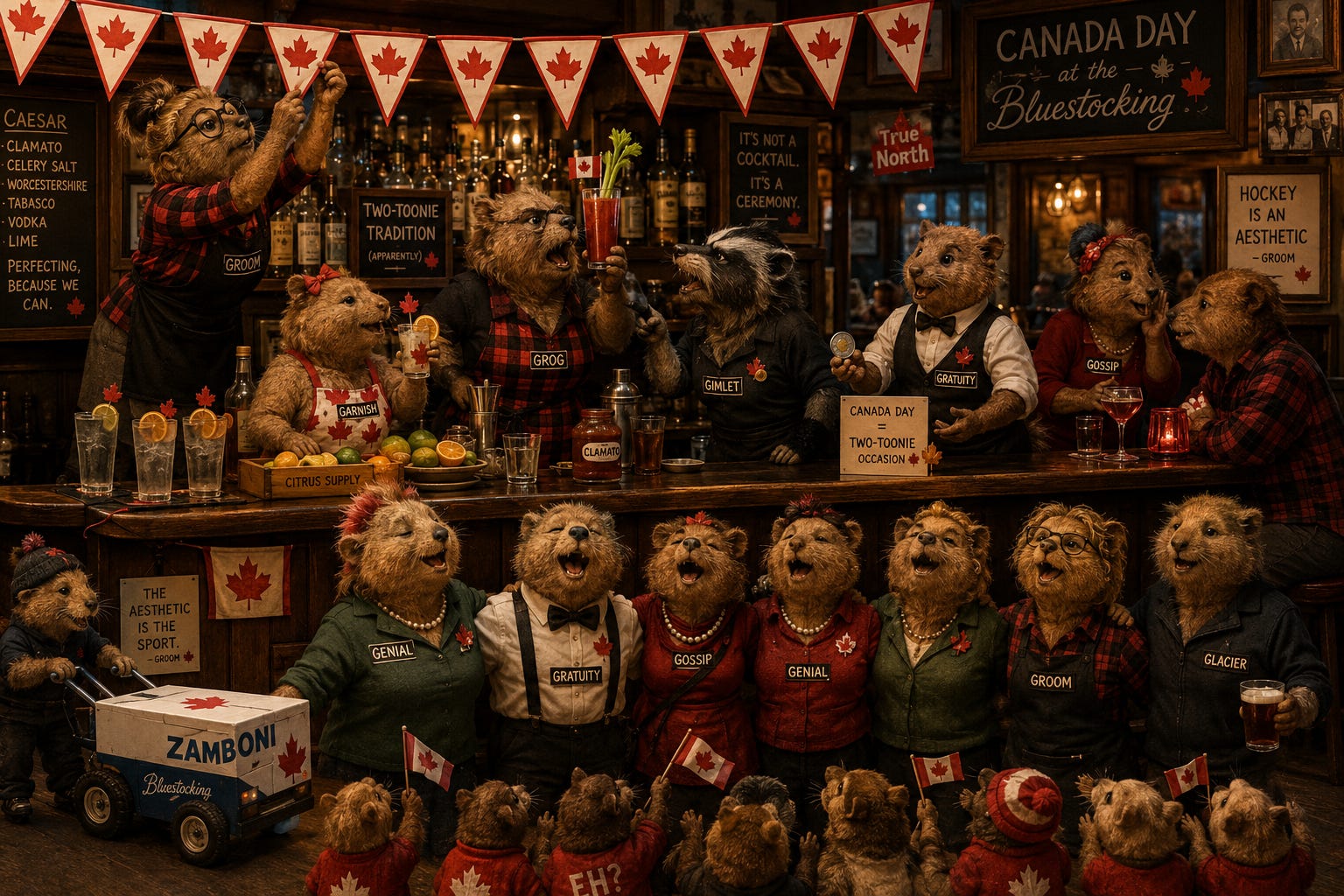

The maple leaf bunting went up at four, strung by Groom with the kind of precision usually reserved for surgery. She stood back, considered the angle of the seventh triangle, and adjusted it by what could not possibly have been more than a millimetre.
“Nobody will notice that,” said Gossip, who noticed everything and said so.
“I will notice it,” said Groom, and that settled the matter.
By five, Garnish had commandeered the entire citrus supply. Every glass that left her station — water, cocktail, the single mysterious cup of something Grog wouldn’t identify — wore a maple leaf twist balanced with the confidence of a woman who had found her purpose in life and intended to milk it for all it was worth. A patron asked, not unreasonably, why her sparkling water needed garnish at all.
“Because it’s Canada Day,” said Garnish, in a tone that closed the subject permanently.
At the bar, the feud had already begun. Grog was three drinks deep into perfecting her Caesar — clamato, celery salt, a rim so aggressively seasoned it could strip paint — purely because the ingredients existed and she had never had an excuse to use them before. None of it would do a thing to her. That wasn’t the point. The point was the ceremony of it, and Gimlet found the clamato offensive.
“Clamato,” Gimlet said, “is not a cocktail ingredient. It is a punishment.”
“It’s tradition.”
“It’s tomato juice with a secret.”
They had been having versions of this argument since noon and showed no sign of resolving it before closing, or possibly ever.
Gratuity worked the floor like a woman running a small, entirely legal extortion scheme. “Canada Day,” she told table six, refilling water nobody had asked for, “is traditionally a two-toonie occasion.” Table six, who had never heard of this tradition because it did not exist, tipped in toonies anyway, mostly out of confusion and mild fear.
Gossip, meanwhile, had told three separate patrons three separate reasons the pub was doing any of this — a liquor licence technicality, a bet Groom had lost, a promise made to a regular’s late mother — and was working on a fourth for the table by the window, refining the story as she went, adding a shipwreck.
Genial floated through it all being pleasant with a thoroughness that had started to feel less like hospitality and more like a hostage situation. “Isn’t this lovely,” she said, to everyone, repeatedly, until even the regulars began to find it faintly menacing.
Ginger had dyed one flank a defiant, patchy red using something none of the others cared to ask about, and wore it like a medal. Glacier delivered a single pint across the span of two hours, moving with such profound unhurriedness that the recipient had finished a second conversation, a cigarette break, and most of an emotional epiphany by the time it arrived. Nobody complained. Nobody dared.
The Zamboni cart came out at nine — a repurposed shoebox on wheels, pushed the length of the bar between “periods” of a hockey game that was not being played, by anyone, at any point in the evening. Groom insisted this was beside the point.
“The aesthetic,” she said, “is the sport.”
And at the end of it, when the last toonie had been extracted and the last maple leaf twist had wilted in the last abandoned water glass, the seven of them lined up along the bar rail — Garnish, Grog, Gimlet, Gratuity, Gossip, Genial, Ginger, Groom, Glacier, more of them than anyone could quite account for when they were all standing together — and sang “O Canada” with more gusto than expected of staff clocking out.
It was, several regulars agreed afterward, wiping their eyes, the most moving thing they had ever seen at closing time.
None of the gerbils understood why. They found this, too, extremely funny.