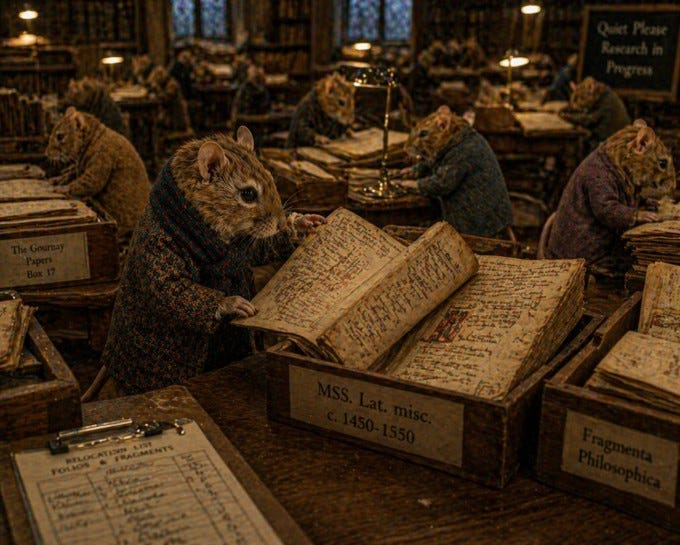

Marie doesn’t give Gosie a lecture. She gives her a lead.
“These things moved through women,” she says. “Copied, translated, passed on. Not hidden—circulated.”
Then she marks one name on a short list. That’s it.
Gosie leaves at first light and heads straight for Oxford.
Not sightseeing. Work.
The name Marie gave her is linked to a small, semi-private collection tied to the Bodleian Library—the sort of place where odd manuscripts end up when no one quite knows what to do with them.
The collection is mid-reorganisation. Boxes open, records messy, people distracted.
Gosie doesn’t sneak. She blends:
moves with purpose
carries a clipboard she didn’t arrive with
looks like she belongs
No one questions a busy small gerbil in a system already slightly chaotic.
She finds it fast.
Not a painting—a manuscript page.
Covered in annotations by multiple women over time. Arguments, corrections, additions. And in the margin:
The same structural mark.
This isn’t art. It’s instructions.
How to assemble the fragments into something coherent.
Then the problem.
A gap.
One item missing from the sequence—recently removed.
Not misfiled. Taken.
Gosie doesn’t linger.
She’s got what she needs:
confirmation this is a distributed work
proof women were building it collaboratively
and certainty the adversary is ahead on the next step
As she leaves, she adjusts one thing—just slightly.
Moves a record. Reorders a reference.
Not enough to be noticed immediately.
But enough to slow someone following her.
Now it’s a race.
And for the first time, Gosie is actively playing it.