
The darkroom door stayed shut until 11, and nobody knocked on it, because the last patron to knock on it while the good chemicals were out had been told, through the door, exactly what her knock had cost in fixer, in paper, and in goodwill, itemised.
When Glossy came out, she came out backwards, holding the prints by their edges, and the room made way for her the whole length of the bar.
There were four of them. She pinned them in a row above the big table, under the existing enlargements, moving Durham along to make space, and stepped back to check the line was level before she would let anyone else near. Durham. Ripon. Norwich. And then the new one, from Ely, printed larger than the rest on the good paper: the mark in the lead of The Visitation, lit sideways by Angle’s torch so the impression stood up out of the metal like a hill at sunset.
It was not a circle. The curve rose and rounded over and gave up at the bottom right, running off in a short trailing tail. Three diagonal lines crossed it from bottom left to top right, evenly spaced, each one carrying on past the curve as though it were not there.
“Right,” said Angle, and told the room what she had established and nothing else. That the mark at Ely was not the Mark of the Margrave but was older because the lead hadn’t been touched since its restoration in the 19th century. That the pale sliver at Norwich, the crescent they had all been staring at for weeks, fitted the Ely curve exactly, edge to edge, when the print was held against the frame. And that this meant the Mark of the Margrave sat on top of this older mark.
She took the Norwich enlargement down, held it against the Ely print, and slid it until the crescent lay along the curve of the headland. It fitted in front of everyone the way it had fitted in the museum.
“I can’t tell you what the old mark means,” said Angle, “because I don’t know.”
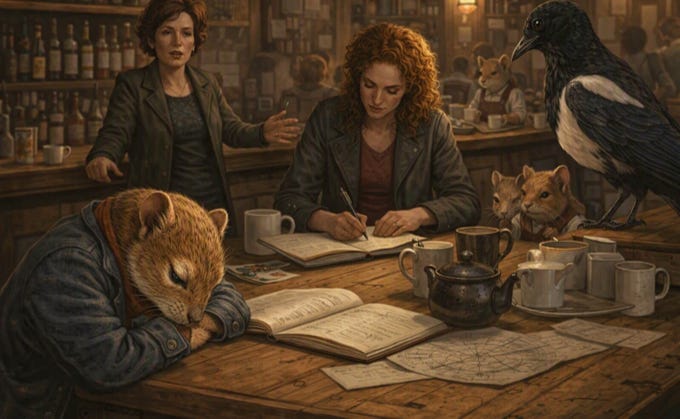
Nobody said anything for a moment. Gasket put the good teapot on the table without being asked.
Magpie had been at the end of the bar through all of it, working through a dish of peanuts with a precision that emptied it without ever appearing to touch it. She came down the bar now, looked at the two prints held together, and put one claw very lightly on the crescent.
“I’ve buried things,” she said. “Rings, mostly. A watch, once, that I maintain was abandoned. A very nice pair of shoes. And I’ll tell you the one rule of burying things: you don’t cover what nobody’s looking for. You cover a thing because you know what it’s worth to somebody, and you know they’re coming.” She took her claw off the print. “Whoever put the Margrave’s mark on top knew exactly what was underneath, and wanted it hidden.”
“Then why was it not hidden on the frame of The Visitation?” asked PastaAllaNorma.
“No idea,” said Magpie. “Maybe it’s not been replaced.”
PastaAllaNorma threw up her hands. “So where do we go from here?”
Angle went back to the wall with the enlarged prints. She picked up the Cathedral Architecture of the British Isles and said, “We look for the Margrave’s mark in the rest of Gosie’s list and when we find it, we look to see if it’s hiding the curved mark. If we’re lucky, we might even find the curved mark itself. Forty-three cathedrals with a chapter house,” she said opening the atlas. “I marked every cathedral that Gosie visited on the map inside the front cover. Ripon and Durham have the mark, and five haven’t been visited at all.”
“Except it isn’t five,” said Gosie. “Ely’s chapter house is now its administrative centre, which has no surviving stained glass, and Norwich’s chapter house hasn’t existed for hundreds of years.” She glanced at Grisaille, who was studying the rim of her teacup with great attention, and said nothing further. “In any case, I went to Norwich because Gemma Glasswing told me she’d worked on a restoration there. That leaves Sheffield and Glasgow Cathedrals and Westminster Abbey.”
“Just three left, then,” said Girdle, hopefully.
“Three,” Gosie agreed.
Magpie looked up from the last of the peanuts. “The fragment said the Margrave paid for the restoration of the Chapter House window, which is why you were looking at chapter houses. You found the right window at Durham Cathedral, which then led you back to Ripon. But the mark at Norwich Cathedral turned up in the nave, not anywhere near a chapter house at all.” She looked at the atlas with its map of cathedrals plotted by Angle. “It isn’t three cathedrals left. It’s three you haven’t been to, three where you found the Margrave’s mark, one where you found the older mark, and thirty-six where you only searched the chapter houses.”
Nobody corrected her.
“Thirty-six cathedrals,” said Angle, half to herself. “Every window in each of them. Not just the chapter house. All of them.”
Gosie sat with her head bowed, her shoulders slumped at the prospect of the impossible task.
It was Marie de Gournay, further down the bar, who spoke next.
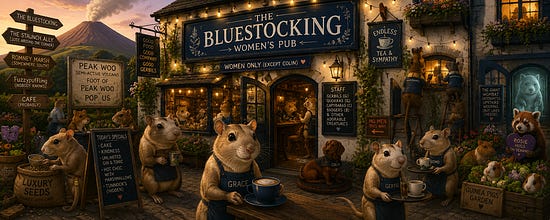
“You went round dozens of buildings on your own the first time, looking at chapter houses,” she said. “You are not going round them a second time on your own to check all the other windows.” She looked round the room, at Angle already reaching for a fresh page, at Magpie sitting up properly now instead of working the peanuts, at all the gerbils quietly serving drinks and snacks. “There are rather a lot of us. We can help.”
Previous Chapter | Contents | Next Chapter