
Angle had been examining the photographs of the symbol for what felt like weeks and was still no further in understanding what lay beneath it.
Glossy had printed everything twice, and then, under protest, a third time, larger, on the good paper. The three marks were now pinned in a row above the big table: Durham, Ripon, Norwich. Beneath each one hung its enlargements, each print bigger than the last, until the grain of the paper gave out somewhere the lead had not. The Norwich print was mostly crescent, the small pale sliver in the north-west crescent where the stamp had sat off true, blown up to the size of a saucer and no more forthcoming at that size than it had been at any other.
Angle sat back from the loupe and put it down with the finality of a tool being retired rather than rested. “I can’t get any further with photographs,” she said. “A photograph tells you what a thing looks like. It doesn’t tell you what it is. I need to see leadwork. Old leadwork, a great deal of it, close enough to touch, and I need it somewhere that won’t require scaffolding, a faculty application, or a verger.”
“There’s a stained glass museum in Ely Cathedral,” said Grisaille, from the armchair in the corner that nobody had noticed she was sitting in. “Been there since the Seventies.”
Nobody looked up. Grisaille's confidence did not dim when she was wrong. It seemed to feed on it. Inside a fortnight she had called "glorious" the windows of a chapter house demolished in the sixteenth century, described in great detail a clothworker in a stained glass window, when it actually depicted a woman with dividers, and claimed with complete confidence that the deeds to Wicken Fen had been stored in a hatbox with a green ribbon.
“It’s up some stairs on the right as you enter the cathedral,” Grisaille said again, quite unbothered. “You have to pay.”
Angle didn’t answer straight away. She opened her laptop and began searching through the internet as though nothing had been said. This was also standard practice, since answering Grisaille at once only encouraged a second and worse fact to follow the first. Then she stopped.
She read the search results once, then a second time with her mouth actually moving over the words, then clicked on the first link at the top of the page in silence, which was somehow worse than the first two.
“There is a museum of stained glass,” she said slowly. “The only one in the country. Historic panels at eye level, several hundred of them. Conservators employed.” She paused, and said, “It is in Ely Cathedral. £6.50 entry fee for adults, £6 for students and children go free if accompanied by a paying adult. It has been there since the 1970s.”
“How much would Gosie pay?” asked Girdle, “she’s not a student.”
“Gosie’s not a child either,” said Gasket.
“She’s the size of a child,” said Gantry.
“She’s the size of a gerbil,” said Gasket. “There isn’t a price for that.”
The room took a moment to absorb this.
“How did you know about the museum?” Girdle said to Grisaille, in the voice of someone hoping to be told something that would make it stop being true.
“A woman told me. On a train. She had a badge.” Grisaille considered the account complete and went back to her tea.
This did not reassure anybody, but the museum was still there.
“Ely,” said Angle, “is only twenty minutes from Wicken Fen.”
Gosie fetched the car keys.
The Stained Glass Museum was indeed on the right of the Great West Door which served as the Cathedral entrance, up a steep spiral staircase.
This was the first thing Gosie held against it, briefly and unfairly, since she had walked past staircases exactly like it in a dozen cathedrals and every one of them had led to an organ loft or a locked door or a sign about the tower tours being seasonal. This one led to a gift shop, and through there to the Main Gallery, which ran high above the nave, the length of it disappearing into a series of white bays like a train of rooms with no doors between them.
The stained glass was mounted in cases on the right side of the gallery with an additional broad spine of cases attached like flying buttresses down the middle and arrows on the floor suggesting mildly that one might walk up one side of the buttresses and back down the other. The arrangement was broadly chronological. The labels were thorough.
Gosie stood in front of a donor panel, working out what was bothering her, and settled on the light. A lightbox lit the glass evenly from behind and everything glowed blandly, with no nuance as from a window lit by sunlight. The lead sat in front of the glow as a black drawing, every line its own silhouette, with most of the lead frame hidden by the display cases.
Angle had a torch. Angle had, in fact, a torch, a folder of prints, two pencils, and a method, and she started at the earliest bay and began working methodically along the cases at the pace of someone who had no intention of being finished by lunch.
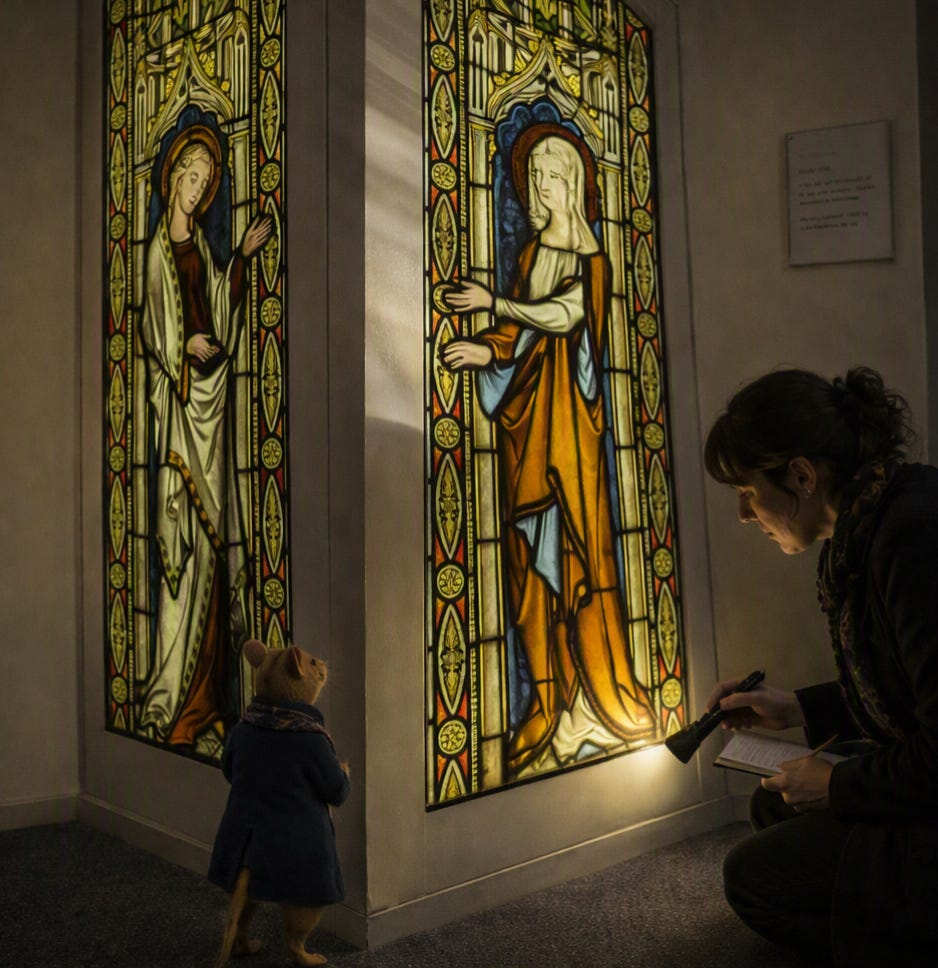
They found The Visitation where the row of cases broke its line and jutted out into the room on a point, a two-faced wedge where two tall panes that had once stood facing each other in a single window were now mounted back to back on the two faces of the angle. The left face featured the Virgin Mary, turned to the right looking demurely down at her belly, while the right face featured Elizabeth, future mother of John the Baptist, facing left and forever looking up into the roof, each figure raising an open hand towards her cousin, yet no longer able to reach her. Only by standing at the apex, where the two faces met edge-on, could a visitor see both panes at once and wonder whether whoever had placed them that way had rather missed the point of the depiction.
Gosie stopped and read the label. It said the panels came from the Hadzor parish church of St John the Baptist, in Hereford and Worcester. The glass was dated to about 1340, and had been heavily restored in 1866 by John Hardman and Co.
“They’re talking,” said Gosie to Angle.
“There’s a symbol,” said Angle.
Previous Chapter | Contents | Next Chapter