
The mill looked much as it had two days before, the sign by the road, the car park with its markings, the smell of hot metal and something resinous under it as soon as the door opened.
“You again,” said Gemma Glasswing, already stepping back to let them in. “I remember you. Durham, wasn’t it? And Ripon. You wrote it all down very carefully, I remember that too, better than most who come through asking questions.” She looked at Hedgehog with open interest. “And who’s this?”
“Hedgehog,” said Hedgehog.
“Well, come through, both of you, mind the bench, there’s acid on the far end and it doesn’t care whose paw finds it first.”
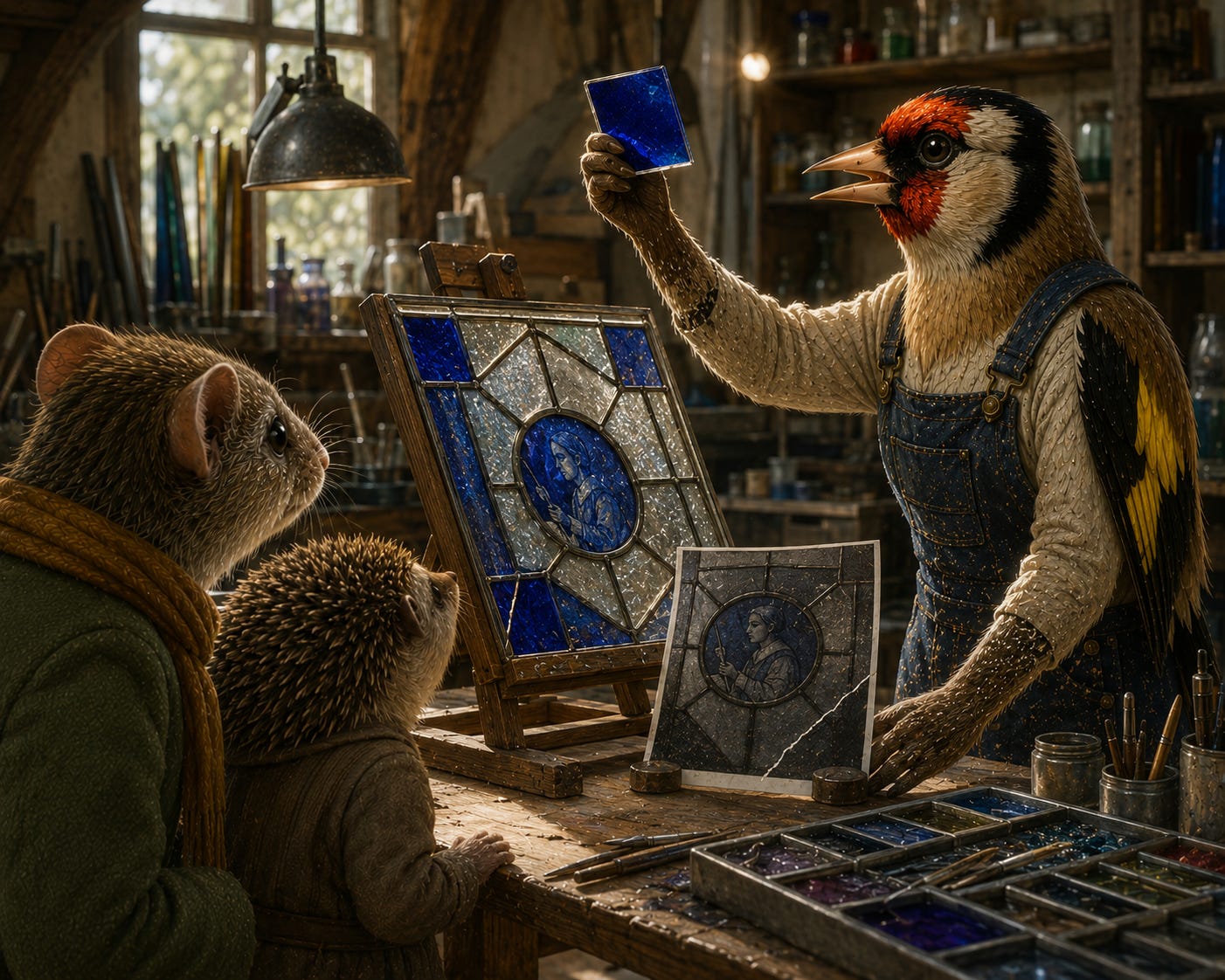
There was a bench near the window now given over to a single piece of work in progress that hadn’t been there two days before, a pane perhaps two feet square, cut and set up on the easel at an angle to the light, the painting begun on one corner and not carried further. Beside it, held down at each corner with small weights against the draught from the door, sat a photograph.
Gemma saw where Gosie had looked and didn’t wait to be asked.
“That’s the reference,” she said, comfortably, the way she might have said the time. “Client sends photographs of every stage of the restoration, high resolution, close as anything, and we work from those. Ink for the grisaille lines has to match a sample. Paint’s specified too, mind, which colour house, which batch even, sometimes they send me what they want to use. Everything matched, that’s the whole job really, matching.”
Hedgehog leaned in over the photograph without touching it. There was a crack, fine, running through one corner. “Even the crack?”
“That’s the thing, though. Normally if it’s in the photograph, it goes in the glass, that’s the whole point of matching, otherwise what am I matching? This time they’ve asked me to leave it out. Copy everything else, identical as always, but not that.” Gemma glanced at the image where it sat. “Which isn’t how I work, not usually. Doesn’t sit quite right, if I’m honest. Cracks are half the reason an old piece reads as old, take one out and you’d think you’d be making the thing look newer, not older.”
“Why this one, do you think?” said Gosie.
“Couldn’t tell you. Something about the schedule, is what I was told, whole job’s moving faster than the others did. Normally I’m only called in once something’s been judged too fragile to be put back, so mine’s what actually goes in, permanent, and the real one goes off somewhere safe. By then all I ever see is photographs of every stage of the restoration. This time they wanted mine started before any of that, working from the original, not the restoration.”
“But they can’t know that yet,” said Gosie. “Whether it’s too fragile. Not before conservation’s finished.”
Gemma shrugged, unbothered. “Told you, not my business, only the how. Whole job’s just moving faster than usual, that’s what I was told, and I don’t ask twice when someone’s paying to have it done quick.”
Gemma Glasswing picked up a small glass sample from the bench, turning it so the light came through it, checking the colour against something only she could see. Hedgehog’s eyes stayed on it a moment too long. “That’s the exact same blue,” she said.
Gemma didn’t look up. “Has to be. That’s what it fires to.” She turned it once more and put it back down. “Sent me that with the brief, this time. Paint goes on looking like nothing at all, so you can’t judge it wet, you judge it against a piece somebody’s already fired. Usually I mix close enough myself and fire my own test. For this one I’ll paint a sample as close as I can, fire it, and see if it matches. Takes a few firings to get it right, but that’s why they use me. I take the time.”
“That’s very particular of them,” said Gosie.
“Well, they can afford to be. Cathedrals don’t have this kind of money lying about, not for glass work, not these days. Comes through Talmere. Their charitable foundation does the funding for the lot of it. I don’t deal with them direct, mind, there’s a workshop manager handles all that side, I just get the brief and the reference and the materials list and I get on with it.”
“And where is the safe place that the originals go to?” said Gosie.
“No idea. Not my end of it. Never has been. I make what goes in, not what comes out.”
“Fair enough,” said Gosie, and left it there.
Gemma Glasswing had already moved on, sorting through a folder with further photographs stacked at the end of the bench, each one paperclipped to a materials list in a hand Gosie didn’t recognise.
“There’s four more of these waiting after this one,” Gemma said, tapping the folder. “Which is four more than I’ve had waiting at once in a good while. That’s four windows all called too fragile to go back, all in the same week. Can’t say I’ve known that happen before, not this many at once.”
Hedgehog had gone very still beside the folder, the particular stillness that meant she was reading something upside down and did not want to be noticed doing it.
“Can I see?” said Hedgehog.
“Course,” said Gemma, and turned the folder round without a second thought.
The top sheet was a photograph, the same close, precise quality as the first, a window Gosie didn’t recognise from the angle, and written beneath it, in the same unfamiliar hand, a single line under Location.
Winchester.
Previous Chapter | Contents | Next Chapter