
It was Hedgehog who said it, over breakfast, in the tone of someone thinking aloud and already regretting it.
“How can it be both?”
Nobody answered straight away.
“The crate we opened on the yacht,” she went on. “Graft says one of those panes is the same glass as the Norwich window. Not similar. The same.” She looked at Gosie. “You stood in front of that window on Tuesday.”
“I did,” said Gosie.
“And the crate was taken by US Customs with everything else. It won’t be released until their investigation and legal process is finished. Months, at least. So how can it also be in Norwich Cathedral?”
“There are two Norwich cathedrals,” said Grisaille. “Roman Catholic and Church of England. They will have made one for each cathedral."
“Then why was one of them in a crate on its way to America?” said Hedgehog.
Gosie said nothing. She had stood in that window’s light on Tuesday and felt only the ordinary weight of somewhere old.
It was Christmas Stars who eventually broke the silence, mostly because a fresh letter had arrived and somebody had to open it.
“Fenella Burnish has written back,” she said, and hadn’t even finished setting the page down before Girdle had it half out of her hands.
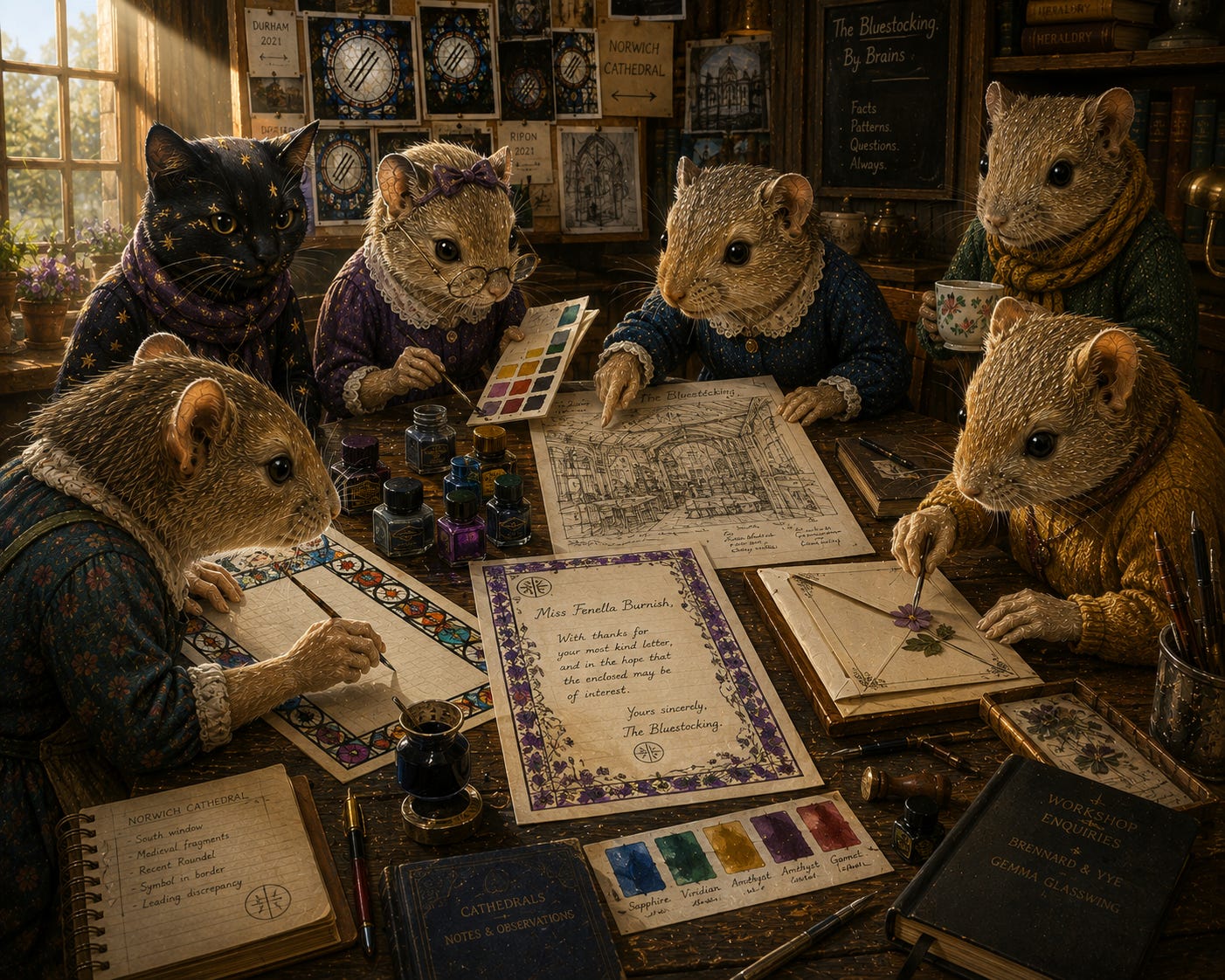
The border this time was violet, worked in a hand as fine as Graphic’s own, and the letter itself ran to a full page where the others had run to three lines.
“It’s her! It’s Fenella!” Girdle held the letter aloft like a trophy. “Look at the violet!”
Griffin abandoned her tea entirely and came round the table for a better angle. “A whole page. She’s never sent a whole page.”
Gasket stood on her chair to see over Griffin’s shoulder, was told to get down, and did not get down.
Gimbal had already started counting the lines out loud, lost count twice, and gave up in favour of simply repeating “a whole page” with rising delight each time, as though the fact improved on retelling.
“Read it,” said Gosie.
Christmas Stars read it. Fenella Burnish had, it turned out, a great deal to say, none of it about availability. She wrote that she had shown Gosie’s last letter to a colleague before she could stop herself, that she had not done that with a piece of correspondence in years, that whoever held the pen had corrected a stroke mid-line in the ivy border not once but twice, and that a printer could copy a shape but could never correct one, and that this, of all things, was what had kept her looking at it for a full quarter of an hour when she had letters from actual solicitors waiting unopened beside it. She wanted, she said, to know the hand. She used the word talent twice and the word rare once and closed by saying she hoped whoever it was knew what they had.
There was a beat of silence, and then the room turned towards Graphic all at once.
“Rare,” repeated Girdle, delighted, rounding on her. “She said rare.”
Gimbal was already halfway out of her chair. “Twice! Talent, twice!”
Griffin reached over and shook Graphic firmly by one paw, as though congratulating her on an engagement. Gasket, still standing on her chair from the last commotion, began a small round of applause that nobody else joined but that she persisted with regardless.
Graphic, at the window, had gone very still.
“She’s not asking about availability,” said Christmas Stars. “She hasn’t gone near it. She just wants to know whose line work it is,” and looked at Graphic, who was suddenly very interested in the state of her own cuff. “Not whether we’re respectable enough to write to. Whether we’re good enough to be worth writing to. So, the question is what we send her.”
“She works in glass,” said Gimbal. “She won’t want line alone. She’ll want colour.”
“Then she should have colour,” said Gasket, and was already halfway to the shelf where the good paints lived, the ones kept for occasions rather than practice.
Griffin produced, from somewhere, a small, folded square of paper that turned out, once unfolded twice more, to be considerably larger than it had any right to be, and announced that a proper letter deserved a proper enclosure.
By the time it was settled, it had stopped being one thing and become several. Gasket mixed colour swatches to go alongside it, a small careful fan of shade against shade, nothing overdone, everything considered. Griffin’s square of paper became a folded diagram of the Bluestocking itself, absurdly detailed, entirely unnecessary, and somehow exactly the kind of thing that would make someone smile despite themselves. Gimbal added a single pressed flower to the corner of the envelope.
Graphic worked last, once everyone else had finished. She set the ivy aside entirely, reached for the shallow tin of inks nobody had seen her use before, and began a border unlike anything she’d sent Fenella so far, a line of interlocking panes, each one a different depth of colour, fitted together the way glass fits into lead.
Angle had been watching this over the top of the atlas for some time, the way she watched most things she pretended not to be interested in, and it was the sight of Graphic’s pen actually moving that seemed to settle something in her.
She waited until the room’s attention had properly drifted back to its tea before she said to Gosie, “I’ve been wrong for two days.” Angle turned the photograph of the Norwich window to face the table properly and tapped the place in the border where the leading deviated from true, in one tiny stretch. “I called this a discrepancy. It isn’t, or not exactly. It’s a mistake. The mark is meant to sit exactly over whatever’s underneath it, cover it completely, and normally it does. Here, whoever set it was very slightly off. That’s the only reason we can see anything underneath at all.”
“Underneath being what?” said Gosie.
“I don’t know yet.” Angle stood and reached for the good pile. “That’s rather the point of going back through every photograph you’ve taken, to see if we can find out what it is. I think it might be important.”
Previous Chapter | Contents | Next Chapter