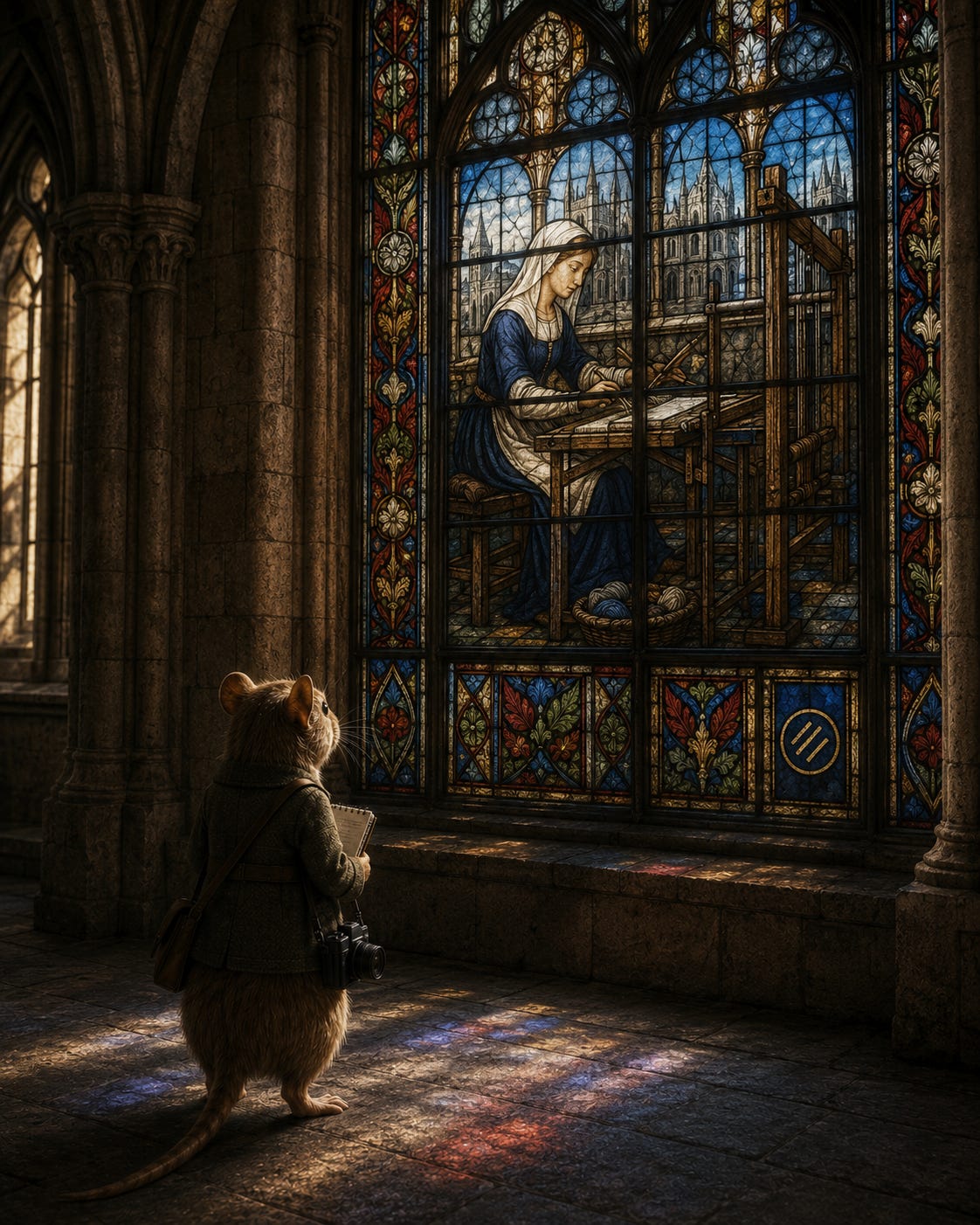

The window was wrong.
Not obviously wrong. Not wrong in the way that would catch a casual visitor, or a verger, or anyone from the conservation trust who had been looking at it for long enough that they’d stopped seeing it. Wrong in the way that things are wrong when someone has been very careful indeed.
Gosie stood very still and looked at it.
The chapter house at Durham dated from 1133, which she knew because she had now read more about chapter houses than she had previously considered possible or desirable. The stained glass was Hugh Easton, 1935 onwards, replacing plain Victorian glass, which had itself replaced whatever the Dissolution had left, which was the typical English ecclesiastical story: centuries of careful arrangement repeatedly interrupted by strong opinions. There were medieval fragments incorporated here and there. This was noted in the literature. The literature was extensive and she had read all of it, which had seemed efficient at the time.
Gosie took out her notebook.
The donor panel was in the lower left corner of the second window, which was where donor panels tended to be, modest, expected, easily unread. Pale lettering on a ground of deep blue. A name, a date, a fund. The glass was recent. Not 1935 recent. Recent recent. The leading was bright where it should have been dark. Someone had replaced this panel within the last three years. More importantly, the someone had been skilled enough that you wouldn’t notice unless you were specifically looking for recent restoration. Gosie was specifically looking for recent restoration, which was the only reason she was here at all.
She photographed it. Then she photographed the leading. Then she stood back and looked at the symbol worked into the border of the panel, which was not in the heritage register description, and which she had seen before, and which was the reason her notebook currently had a system.
She did not let herself feel anything about the system being vindicated. There would be time for that later. Possibly with a drink.
~~~
The list had started with forty three.
This had not been clear at the outset. At the outset, chapter houses with stained glass requiring conservation attention had sounded like a reasonably finite category. It was the word requiring that had done the damage.
The fragment of paper, no bigger than a ticket stub, had been in Gosie’s pocket for the last three months. Found among the Talmere Logistics papers seized from the smugglers they’d apprehended in Portland, Maine, it said only: Donation for Chapter House Window Preservation Fund. Paid on behalf of Margrave. A symbol showing three diagonal lines crossing a circle was visible in the left margin. It was the only thing that linked the Margrave to Talmere and the smuggling operation. Gosie had told no one else about it.
She’d initially filtered for active projects, then realised the Margrave would not be so straightforward, and expanded to completed projects in the last decade, and then in the last twenty years to account for planning time, and by then she had forty-three locations and a spreadsheet that she was not going to tell anyone about because it had become slightly embarrassing.
She had started in the south, which had seemed logical.
Canterbury had been first. The chapter house at Canterbury had no windows to speak of, according to Grisaille, a fact which was apparently well-documented, and which Gosie had not successfully established in advance. She walked into the chapter house expecting nothing, only to find magnificent stained glass at both ends. She stood in it and then stood in it longer than necessary because the windows were extraordinary and she was only a gerbil. Victorian glass. Donors long dead. Nothing recent. Nothing placed. But utterly beautiful.
Rochester had been a disaster. The chapter house at Rochester had lost its roof in the 1540s and never got another, leaving it open to the sky, walled in blind arcading where windows might once have been imagined, which Grisaille had described in advance, with total confidence, as “glorious, some of the finest glass in Kent.” This fell apart on every count, because there was no glass, because there was no roof, because a roof is generally considered load-bearing for the concept of a window. Gosie stood where the monks used to sit and looked up at nothing. Grisaille’s notes had specifically mentioned that the light through the east window was “particularly fine in the afternoon.” There was no east window. There had never been an east window, not since Henry VIII took an interest in the roof, which is to say permanently. Gosie noted this down. She did not say anything. There was no one there to say it to.
Wells had windows. Wells had extensive windows, carefully listed, recently surveyed, with complete donor records going back to 1987 and a very helpful archivist named Deirdre who wanted to discuss the provenance of a particular blue for considerably longer than Gosie had time for, though she had stayed for the full hour because Deirdre clearly didn’t get many visitors and also because the blue was genuinely interesting.
It had not been the right blue.
Lichfield. Salisbury. A chapter house in Lincolnshire that turned out to belong to a private trust and was locked, with a number to call that rang without answer. She had written the number in the notebook under a heading she had since removed.
Worcester had been promising. Worcester had a recent restoration, a sympathetic glazier, a conservation report with appendices from Grisaille. Gosie had read the appendices on the train to Hereford, and then reread them on the train back from Hereford, having discovered that the chapter house windows had been destroyed during the Civil War. Grisaille’s summary had described them as untouched since 1320, which was the kind of sentence that required a certain confidence to write, given they had been replaced by the Victorians.
She had become a sandwich connoisseur. Cathedral tea shops operated, Gosie had concluded, on the assumption that the visitor’s appetite had been suppressed by spiritual elevation and required only token restoration. The sandwiches were priced as though this were a reasonable cost for the ingredients involved.
By the time Gosie reached York she had stopped looking at the architecture.
This was, she knew, a personal failing. York Minster’s chapter house was extraordinary, octagonal, no central pillar, windows of quite startling ambition for the period. She had noted this without feeling it, which told her something about where she was. Gosie had sat in it for twenty minutes thinking about the sandwich she’d just eaten: egg, and not in an interesting way, and looked at windows that would under other circumstances have held her for hours, and thought: seven more.
Six, after Ripon.
Then Durham. Number thirty eight.
She had almost skipped Durham. The chapter house windows were described in the survey as of moderate decorative interest, largely intact, conservation works completed 2021. Moderate decorative interest was heritage register language for not the main event. She’d put it near the bottom of the list and worked through thirty-seven others first, and then come here on a grey Tuesday because she was in the northeast anyway and because there were five left and she was going to finish the list properly.
She was glad, now, that she was a gerbil who finished lists properly.
She looked at the symbol in the border of the donor panel for another moment. Then she took one more photograph, from a slightly different angle, and put the notebook away, and walked back through the cloister toward the exit in a way that did not suggest she had found anything at all.